
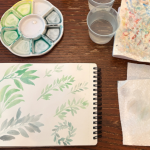
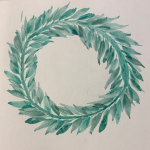
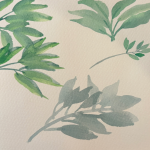
Recently, my daughter and I were talking to one of her friends and their parents, and the subject of hobbies came up. When her friend mentioned art classes, my daughter proudly announced, “My mom knows how to paint watercolors!” Everyone turned to look at me. I smiled and thought, but didn’t say: Actually, I only paint leaves.
I’ve been building up to painting leaves since 2022, when I purchased my first set of watercolors not made by Crayola. I added a block of cold press paper and a porcelain palette in 2024. I collected workbooks and brushes. I bookmarked Reddit threads. Finally, I requested Everyday Watercolor: Learn to Paint Watercolor in 30 Days by Jenna Rainey as a birthday gift, one of the most recommended resources on the aforementioned Reddit threads. My birthday was four months ago. I have yet to reach day seven of Everyday Watercolor, despite the book living up to every rave review. So: leaves.
Part of the issue is that I am not fulfilling the “every day” step of Everyday Watercolor. At best, I’m “every week”; sometimes “every month.” And I learned how to paint other things before advancing to leaves: straight lines and curves, circles and triangles. Technically, days five and six teach “compound strokes” and “complex curves,” but in practice: leaves.
When I envisioned learning how to paint watercolors, a small part of me wondered if I would pick up a brush and discover I was a modern-day Monet (I don’t think Monet used watercolors, but my subconscious didn’t know that.). Perhaps I’d start by capturing landscapes on vacations. Maybe I’d knock out a few portraits of family members and pets. Instead of pulling out my phone’s camera, I would pull out my brush and sketchbook! (This might be a good time to mention that I’m not particularly good at painting leaves. Or circles. Or straight lines. I feel pretty confident with triangles, though.)
By now, my subconscious and I have learned that if you want to paint a landscape, you have to start by painting lines. Eventually you can move up to leaves. (I don’t know what comes after leaves; ask me in a few months.) Maybe one day I’ll paint a forest. Until then, I have to take it leaf by leaf.
Of course, this blog is about writing, not painting. But I’m finding that many of the same lessons apply.
While painting another batch of leaves, I was reminded of some famous writing advice that also stemmed from an unusual source: a report on birds. As Anne Lamott wrote in Bird by Bird: Some Instructions on Writing and Life, “Thirty years ago my older brother, who was ten years old at the time, was trying to get a report on birds written that he’d had three months to write. It was due the next day. We were out at our family cabin in Bolinas, and he was at the kitchen table close to tears, surrounded by binder paper and pencils and unopened books on birds, immobilized by the hugeness of the task ahead. Then my father sat down beside him, put his arm around my brother’s shoulder, and said, ‘Bird by bird, buddy. Just take it bird by bird.’”
You’re probably not struggling with a report on birds or with painting a straight line. But maybe you have an idea for a book that you haven’t been able to realize on the page. Maybe a setting or character feels flat. Maybe a tricky plot point continues to elude you. If so, try finding a way to break down the challenge you’re facing into smaller, less-daunting parts. Instead of focusing on fixing your entire plot, can you focus on a single scene? Instead of building a complete world, can you envision one room? Instead of trying to revise your entire manuscript, can you revise a single page? Eventually, the challenges you’re facing will start looking a little smaller. 90 birds to research instead of 100. 50 pages to revise instead of 75. 30 leaves to paint instead of 40.
You might also find value in trying something new. Especially if you’ve been writing for some time, it can be freeing to see yourself as a complete beginner again. To allow yourself to paint malformed leaves, to play off-key music, to take fuzzy photographs. Perhaps exploring another medium will unlock something about your writing. Maybe you’ll find yourself more willing to write a bad draft so that you can eventually revise it into a better one. Maybe you’ll notice a new detail you can add to your world or characters. Maybe you’ll simply remind yourself that good writing, like any good art, requires taking one shaky step at a time.
Word by word, bird by bird, leaf by leaf.
Your Editor Friend,
Julie